

If you spend enough time listening to AI vendors, you’d think every enterprise should already have autonomous agents, conversational analytics, and AI-powered decision-making running across the organization. The message is often the same: move fast or risk being left behind.
Yet when you talk to actual data leaders, a different story emerges.
Many organizations are moving carefully. They’re running pilots instead of company-wide rollouts, evaluating multiple approaches before making platform decisions, and building governance frameworks before opening access to thousands of employees. At first glance, this caution can look like resistance. In reality, it’s often a sign of maturity.
The Difference Between a Demo and a Deployment
Most AI technologies look impressive in a controlled demonstration. The data is clean, the questions are predictable, and the use case is carefully selected to showcase the best possible outcome.
Enterprise environments are rarely that simple.
Data is spread across multiple systems. Business definitions vary by department. Security requirements are complex, and regulatory obligations can place limits on how information is accessed and shared. What works during a thirty-minute demo often becomes significantly more complicated when deployed across an entire organization.
That’s why many data leaders are less focused on what AI can do today and more focused on how it can operate reliably over the next several years.
The Technology Is Moving Faster Than the Playbook
Part of the challenge is the sheer pace of change. A year ago, many organizations were evaluating copilots. Today, they’re discussing agents. New models, frameworks, and platforms seem to appear every week, while capabilities that felt groundbreaking six months ago quickly become standard features.
This creates a difficult balancing act. Organizations want to take advantage of new opportunities, but they also recognize the risk of building processes around technologies that may look very different in twelve months.
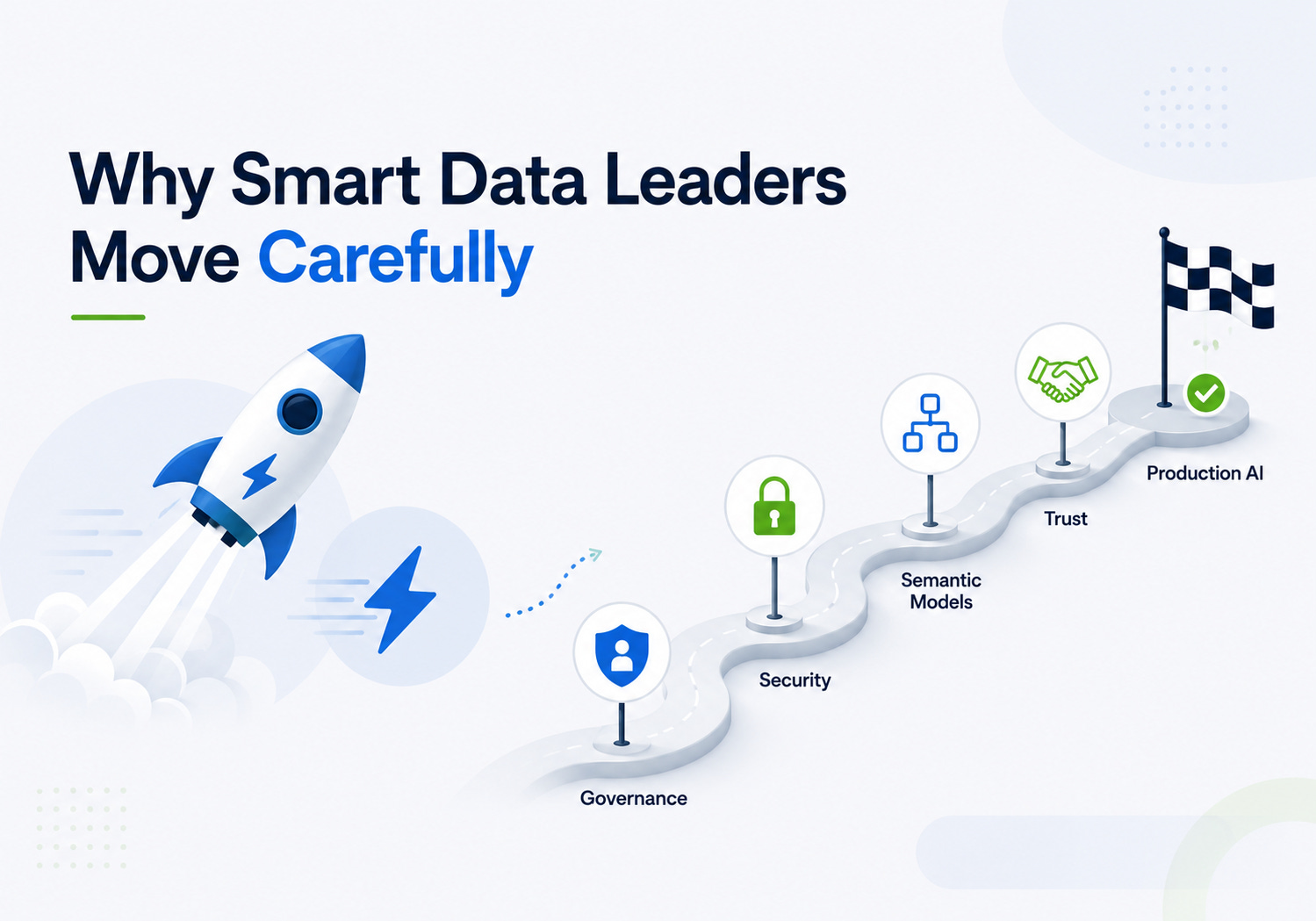
As a result, many data leaders are prioritizing foundational capabilities such as data quality, governance, semantic consistency, and security rather than chasing every new feature announcement. They understand that while tools may change, strong foundations remain valuable regardless of which platforms ultimately win.
AI Is No Longer Just a Technology Decision
One of the biggest misconceptions about enterprise AI is that it’s primarily a technology initiative. While technology is certainly part of the equation, most organizations quickly discover that the harder questions are operational.
Before AI can scale, leaders need answers to questions around governance, accountability, security, and cost management. How will sensitive data be protected? How will outputs be validated? Who is responsible when answers are incorrect? How will usage and spending be monitored over time?
These concerns aren’t signs of bureaucracy slowing innovation. They’re signs that organizations are moving beyond experimentation and beginning to think about production-scale deployment.
The Questions Have Changed
Not long ago, the primary question surrounding AI was whether the technology could actually deliver meaningful business value.
That question is largely settled.
Most data leaders already know AI can generate insights, answer questions, summarize information, and accelerate analysis. The conversations happening today are much more practical.
Can we trust the outputs?
Can we govern the process?
Can we control the costs?
Can we scale this across the enterprise?
These questions take longer to answer than a product demo, but they’re ultimately the questions that determine whether an AI initiative succeeds or becomes another short-lived experiment.
Moving Slowly Doesn’t Mean Standing Still
The organizations generating the most value from AI are rarely the ones making the loudest announcements. More often, they’re the ones quietly building the infrastructure, governance, and business processes needed to support long-term adoption.
That approach may not create the same sense of urgency as vendor marketing, but it reflects the reality of enterprise transformation. Most leaders aren’t looking for the fastest path to implementation. They’re looking for the most sustainable path to business value.
In a market that often celebrates speed, it’s easy to mistake caution for hesitation. But many of the smartest data leaders aren’t moving slowly because they don’t believe in AI.
They’re moving carefully because they do.