

For much of the past two years, the analytics industry has been focused on proving what AI can do.
Can it generate SQL? Can it summarize data? Can it explain trends? Can it answer business questions without requiring users to understand the underlying data model?
For the most part, those questions have been answered. Modern AI systems are increasingly capable of performing analytical tasks that would have seemed ambitious only a few years ago. Business users can ask questions in natural language, analysts can accelerate workflows, and organizations are beginning to rethink how people interact with data.
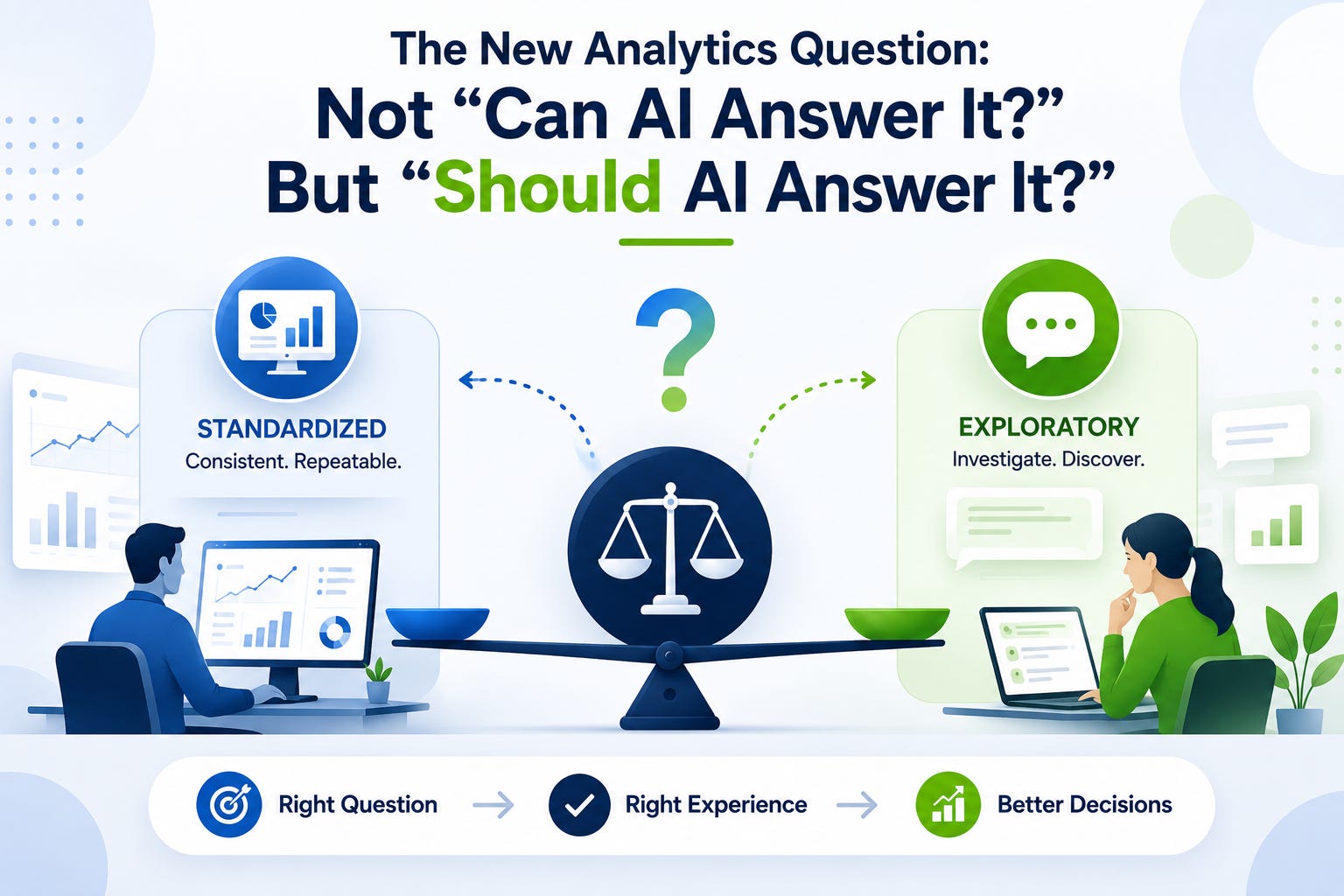
As AI capabilities mature, however, a different question is emerging inside enterprise data teams. It’s no longer enough to ask whether AI can answer a question. Data leaders are beginning to ask whether AI should answer it in the first place.
That distinction may sound philosophical, but it has practical implications for everything from analytics strategy and governance to user adoption and cost management.
The Risk of Treating Every Question the Same
One of the most common assumptions surrounding AI analytics is that natural language interfaces will eventually become the primary way people consume information. If users can simply ask questions and receive answers, why maintain dashboards, reports, and other traditional analytics assets?
The answer lies in the nature of the question being asked.
Not all business questions require exploration. In fact, many of the most important questions inside an organization are remarkably consistent. Executives review the same KPIs every week. Operations teams monitor the same performance metrics every day. Finance organizations distribute the same reports every month. These workflows exist because the business benefits from consistency. Everyone is looking at the same numbers, interpreted through the same lens, using the same definitions.
In these situations, AI may be fully capable of generating the answer. The more important question is whether generating the answer dynamically creates more value than delivering it through a standardized experience.
The answer is often no.
Where AI Creates the Most Value
The strongest use cases for AI analytics tend to involve uncertainty.
A business leader wants to understand why churn increased. A sales manager notices a decline in pipeline performance and wants to identify contributing factors. An operations team needs to investigate a sudden shift in customer behavior. These questions rarely have predefined paths. Each answer leads to another question, and the analytical process becomes iterative.
This is where AI excels.
Rather than forcing users to navigate dashboards, locate datasets, or wait for analysts to produce custom reports, conversational analytics enables a more natural process of discovery. Users can investigate, refine, and explore ideas in real time.
The value isn’t simply that AI produces an answer. The value is that it accelerates the process of finding the right answer.
That distinction is important because it highlights where AI provides unique capabilities rather than simply replicating existing ones.
The Economics Matter Too
As organizations move from experimentation to production, another factor is becoming increasingly important: efficiency.
Historically, dashboards were designed once and consumed repeatedly. A single report could support hundreds or thousands of users with minimal incremental cost. AI introduces a different model. Answers are often generated dynamically, which means organizations need to think more carefully about how analytical workloads are distributed.
If hundreds of users repeatedly ask the same question, it may be technically possible to generate a new response every time. That doesn’t necessarily make it the most effective approach.
This is why many organizations are beginning to think about analytics experiences in a more nuanced way. Some information is best delivered through standardized dashboards. Some is best generated through AI-powered exploration. Increasingly, some may be delivered through agents that proactively analyze data and distribute insights before users even ask for them.
The goal is not to maximize AI usage. The goal is to maximize business value.
The Future of Analytics Is Intentional
The most successful analytics strategies over the next several years will not be defined by how aggressively organizations adopt AI. They will be defined by how intentionally they deploy it.
Dashboards will continue to play an important role because many business processes depend on consistency and governance. Conversational analytics will become increasingly valuable because exploration and discovery are central to decision-making. AI agents will likely emerge as a third layer, automating recurring analytical workflows and surfacing insights proactively.
Rather than replacing one another, these experiences will coexist.
This is why the conversation around AI analytics is beginning to mature. The debate is no longer about whether AI can answer business questions. For most organizations, that capability is already becoming a reality.
The more strategic question is where AI creates the most value, where traditional approaches remain effective, and how the two can work together to support better decisions.
Because ultimately, the future of analytics won’t be determined by the sophistication of the technology alone.
It will be determined by an organization’s ability to apply the right technology to the right question.