

Few topics in analytics generate more debate right now than the future of business intelligence.
Depending on who you ask, dashboards are either on the verge of extinction or as essential as they’ve ever been. Every week seems to bring a new prediction about conversational analytics replacing BI tools, AI agents replacing analysts, or natural language interfaces becoming the primary way people interact with data.
The reality is likely much less dramatic.
Most organizations aren’t choosing between dashboards and AI. They’re trying to determine where each creates the most value.
That’s a far more important question.
Why the “Dashboards Are Dead” Narrative Falls Short
The argument against dashboards is easy to understand. If users can simply ask questions in natural language and receive immediate answers, why would they need to navigate reports, filters, and visualizations?
For exploratory analysis, that’s a compelling vision. Many business users don’t know how to write SQL, build dashboards, or formulate complex analytical queries. Conversational analytics lowers those barriers and makes data more accessible to a broader audience.
But the assumption that every business question should be answered through a chat interface ignores an important reality: not all questions are exploratory.
Organizations have countless metrics that need to be monitored consistently. Executive teams need standardized scorecards. Regulatory reporting requires repeatability. Operational leaders need visibility into performance indicators that are reviewed daily, weekly, or monthly.
In these scenarios, dashboards aren’t a limitation. They’re an efficient delivery mechanism for information that needs to be consumed repeatedly and interpreted consistently.
Not All Questions Are Created Equal
One of the most useful ways to think about the future of analytics is to categorize questions by the type of answer they require.
Some questions are standardized.
What was revenue last quarter?
How are we performing against plan?
What is our claims processing volume this month?
These questions typically have agreed-upon definitions, established metrics, and recurring audiences. Dashboards are often the best solution because they provide consistency, governance, and a shared understanding of performance.
Other questions are exploratory.
Why did revenue decline in one region but not another?
What factors are driving customer churn?
Which operational changes contributed to an increase in claim volume?
These questions require investigation. The user may not know the next question until they see the first answer. This is where conversational analytics and AI-powered exploration can be transformative.
The mistake many organizations make is assuming both categories should be handled the same way.
The Emerging Middle Layer
The discussion often focuses on two endpoints: dashboards and chat. Increasingly, however, organizations are discovering a third category that sits between them.
AI agents.
Unlike dashboards, agents don’t wait for someone to open a report. Unlike conversational analytics, they don’t require users to initiate every interaction. Instead, they proactively perform recurring analysis and deliver insights through the channels people already use.
A sales leader might receive a weekly pipeline analysis. A customer success manager might get a summary of at-risk accounts. An executive team might receive an automated business review before a leadership meeting.
These workflows have traditionally required significant analyst effort. AI agents are making it possible to automate much of that work while still providing context and explanation.
As a result, the future analytics stack is becoming more nuanced than many people expected.
A Better Framework for the Future of BI
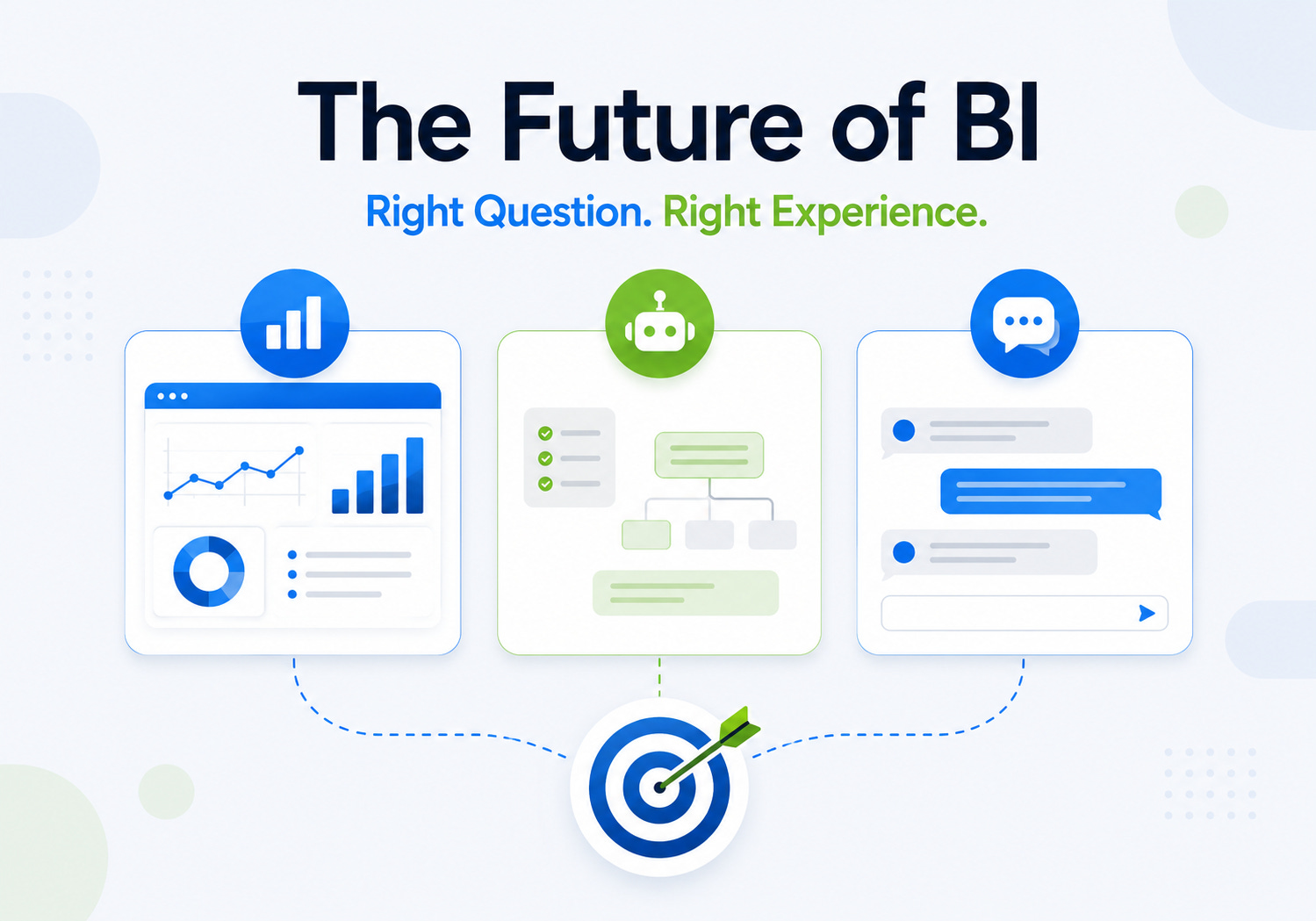
Rather than asking whether AI will replace dashboards, organizations should be asking which experience is best suited for a particular type of question.
Dashboards remain highly effective for monitoring business performance, tracking KPIs, and creating alignment around core metrics.
Conversational analytics excels when users need to investigate, explore, and ask follow-up questions.
AI agents are emerging as a powerful mechanism for recurring analysis, automated reporting, and proactive insight delivery.
Each serves a different purpose. The goal isn’t to choose one over the others. It’s to understand where each fits within the broader analytics strategy.
The Real Opportunity
The most successful organizations won’t be the ones that replace dashboards with AI. They’ll be the ones that create a more intentional relationship between users and data.
That means recognizing that some questions deserve standardized answers. Others deserve exploration. And increasingly, some deserve automation.
The future of BI isn’t a battle between dashboards and AI.
It’s a much more practical exercise: determining which questions deserve each.
Organizations that get that balance right won’t just improve analytics adoption. They’ll create a more scalable, efficient, and trusted decision-making environment—one that combines the strengths of traditional BI with the flexibility of modern AI.