

For the past decade, we’ve been told that the ultimate goal of data strategy is “democratization”—putting data and dashboards in everyone’s hands. But as we close 2025, that narrative is changing. We are crossing the Agentic AI Event Horizon, a shift where the primary consumer of your data will no longer be a human staring at a screen, but an autonomous AI agent executing a workflow.
2024 and 2025 were the years of the Charismatic Storyteller - impressive, sometimes hallucinating LLMs that could write a poem but couldn’t be trusted with a P&L. 2026 is the year we finally give that Storyteller a boss: the Detailed Librarian of the semantic layer.
Here are the four trends that I believe will determine who wins in 2026.
1. 2026: The Year of the AI Reckoning
If 2025 was the year of the pilot, 2026 is the year of the payoff - or the write-off. We are moving from hype to hard hat work. The era of vibe coding and endless POCs is ending. Forrester predicts a “pragmatic reset,” where organizations will delay AI spend if they can’t prove ROI.
This isn’t the end of AI; it’s the maturation. We are seeing a transition from passive Copilots that wait for a prompt to active Agents that perform jobs. These agents aren’t just summarizing emails; they are negotiating supply chains and managing inventory. But to do that, they need more than a prompt - they need a reliable operating system.
2. The K-Shaped AI Divide
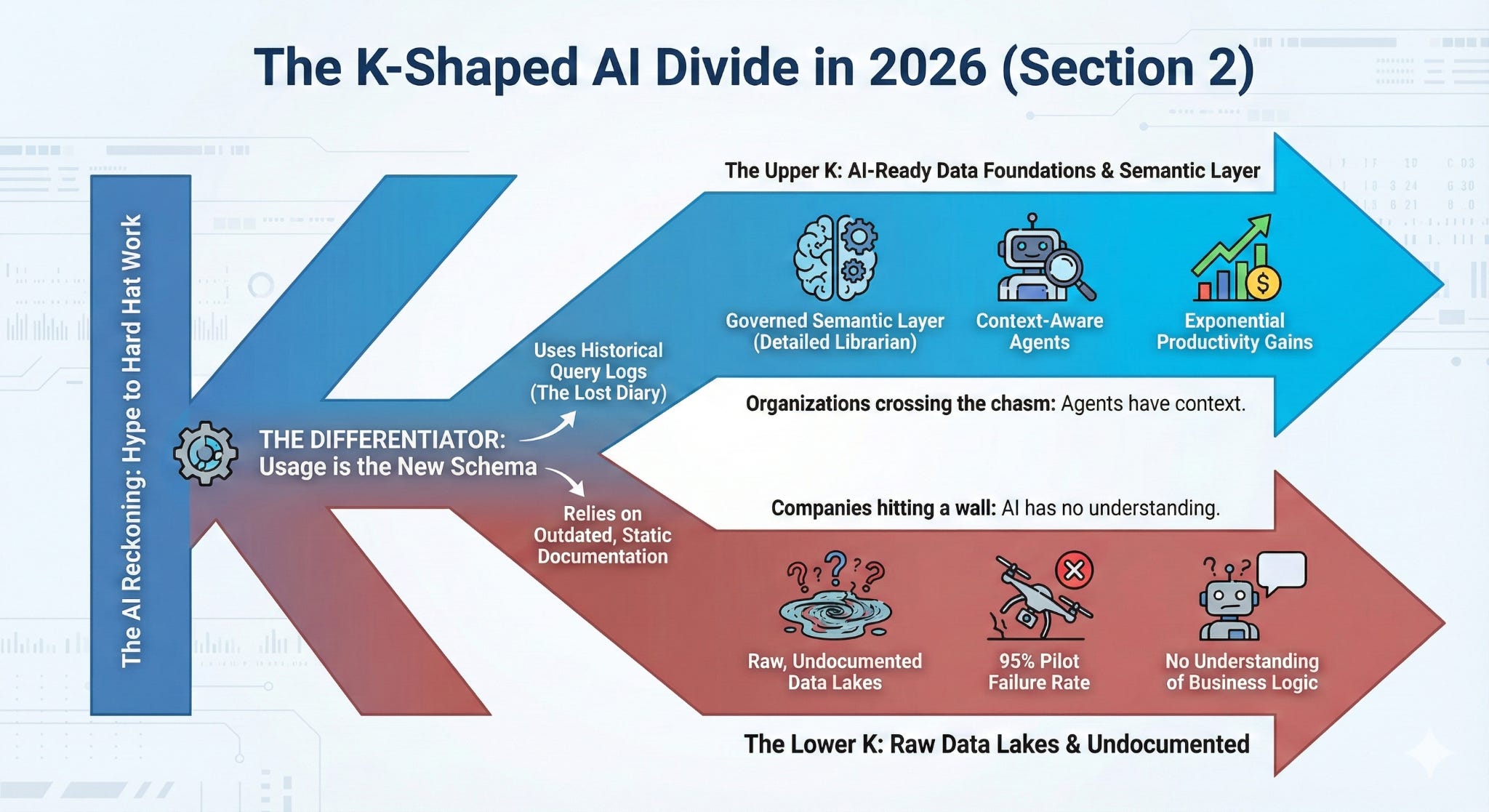
This reckoning is creating a sharp K-shaped divide in the market.
The Upper K: Organizations that invested in AI-Ready data foundations - specifically, a governed semantic layer that can educate the agents how to best use the data - are crossing the chasm. They are seeing exponential productivity gains because their agents have context.
The Lower K: Companies that fed their agents raw, undocumented data lakes are hitting a wall. 95% of these pilots are failing to deliver return on investment because the AI has no understanding of business logic.
The differentiator is simple: Usage is the new schema. The winners are those who used their historical query logs (their Lost Diary) to teach their agents what the data actually means, rather than relying on outdated, static documentation.
3. Governance as the “Agentic Enabler”
We used to view governance as a brake pedal—something that slowed us down to keep us safe. In 2026, governance is the steering wheel. Without it, your autonomous agents are just unguided missiles.
Gartner predicts a rise in “death by AI” liability claims for companies without sufficient guardrails. But the positive flipside is that a robust semantic layer acts as a “Liability Shield.” By embedding governance directly into the data layer (metrics, security policies, context), you aren’t restricting the AI; you are liberating it to act autonomously within safe boundaries. A semantic layer turns a “Black Box” risk into a “Glass Box” asset, allowing agents to reason transparently and enabling you to trust them with your checkbook.
4. The Rise of the “Semantic Auditor”
As AI agents take over the heavy lifting of code generation and data transformation, the role of the human analyst is undergoing a profound shift. We are moving from Builders to Auditors.
Gartner forecasts that by 2026, 50% of organizations will require “AI-free” skills assessments. Why? Because when the machine writes the SQL, the human’s value lies in the ability to critique it. We don’t need more people who can write a LEFT JOIN from memory; we need “Semantic Auditors” who understand the business logic deeply enough to spot when an agent has hallucinated a relationship that doesn’t exist. The analyst of 2026 is the guardian of “Ground Truth,” ensuring that the “Charismatic Storyteller” adheres to the facts kept by the “Detailed Librarian.”
The Bottom Line
The “AI-Readiness Gap” is real, and it is widening. You cannot buy an agentic future; you have to architect it. The organizations that thrive in 2026 will be those that stop treating data documentation as a chore and start treating it as the cognitive architecture for their digital workforce.